
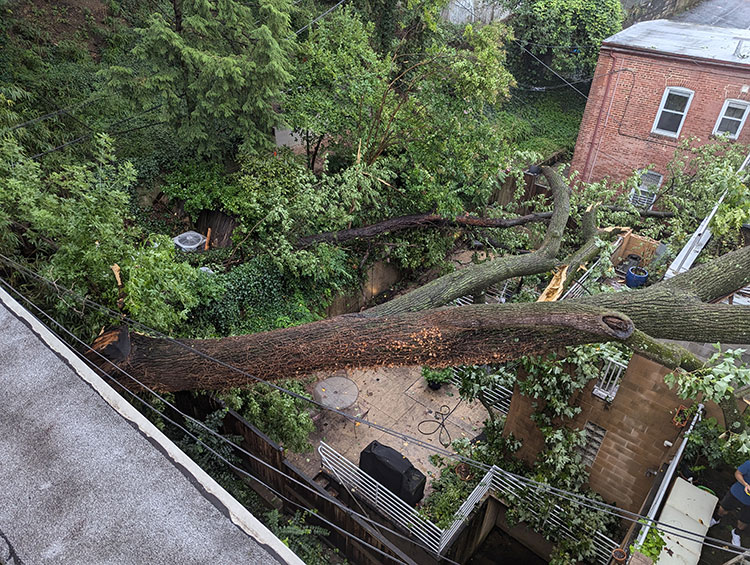
9 Injury Prevention Tips When Felling Trees
If you have never done it before, felling a tree can look simple.
You make a few cuts, the tree falls, you clean up the branches, and you’re done. Having this impression leaves out the most important part: tree cutting does not always go according to the plan.
A tree can split, twist, kick backward, roll, drop a branch from another tree, or pull something down with it.
A perfectly healthy-looking tree can also have decay, root problems, tension or internal cracks that you can’t see from the ground.
After years providing tree services, we have one rule:
The safest tree felling plan is the one that protects you when something goes wrong.
That means your first job is not cutting.
Your first job is figuring out what could hurt you.
To help you out, here are tips that you should put into place to ensure that you don’t get hurt when felling a tree:
Always gear up
At all times when you are cutting a tree you should have a helmet with a face screen, hearing protection, chaps, steel-toe boots and gloves.
This might feel like an overkill for “just one tree.” But here’s the thing: injuries don’t happen on the trees you’re nervous about. They happen on the “easy” one you got sloppy on.
Simply wearing chainsaw chaps means that you stop a running chain from reaching your leg. That’s not a nice-to-have gear. That’s the difference between a scare and a trip to the ER.
Inspect the tree
Before any cutting happens, walk a full circle around the tree. Look up, not just at the trunk.
During the inspection you’re checking for:
- Dead branches hanging in the canopy (these are called widowmakers for a reason, and they kill people every single year)
- The direction that the tree naturally leans
- Whether the tree is tangled in a neighboring tree’s branches
- Presence of power lines, fences, sheds, or anything else in the fall path
When you are doing the inspection, take your time. Remember that skipping the inspection is how people end up under something they never saw coming. And you don’t want this, do you?
Plan your escape beforehand
You need two escape routes, angled away from where the tree is going to fall. You should clear this area for sticks and debris before you start cutting.
Picture it like this: the tree is falling, and you need somewhere to walk to calmly, not sprint to in a panic.
If your “path” has a wheelbarrow or a garden hose in the middle of it, that’s not a path. That’s a hazard.
Pick your route, clear it, and know it before the saw ever touches bark.
Give the tree room to fall
A good rule you should follow is to clear the space around the tree that’s at least twice its height, and make sure everyone else, kids, pets, neighbors, is outside that zone before you start.
The reason for this is that trees don’t always fall where you plan. Wind, tree rot, weight distribution, all of it can send a tree in a direction you didn’t expect.
Distance is free insurance. And you should have enough of it.
Know when a tree is beyond your skill level
Some trees are not a DIY job, and there is zero shame in admitting that. Call a professional if:
- The tree is leaning toward your house, a power line, or the neighbor’s property
- It’s dead, rotting, or hollow (you can tell a tree is hollow when you knock the trunk and it makes a hollow sound. It might also have visible fungus and soft spots)
- It’s tangled up with other trees
- It’s larger than you can comfortably wrap your arms around
- The wind is too strong
A professional arborist has insurance, training, rigging equipment, and they will comfortably handle even the most complex projects.
Remember that paying the professional is a lot cheaper than paying for a hospital visit or a roof.
Keep an eye on the weather
Wind is the one variable that can turn a routine cut into a genuine hazard. Even a moderate breeze can shift a tree’s fall direction or send a “dead” branch down without warning.
If the weather conditions don’t feel right, they aren’t. Reschedule. There is no harm in it.
The tree will still be there tomorrow.
Listen to your body
Felling a tree is physical work, and when you do it when you are fatigued, you are bound to make mistakes. Your grip loosens. Your attention wanders. Your reaction time slows down right when you need it most.
The right thing to do is to take breaks and stay hydrated.
If your arms are shaking or your focus is drifting, stop for the day.
As long as the tree isn’t too dangerous in its current condition, you shouldn’t force yourself to cut it.
Postpone the cutting and come back when your body is ready.
Never cut alone
Always have someone else nearby, within earshot, who knows what you’re doing and can call for help if something goes wrong.
They should not be standing next to you, but they should be close enough to notice if you go quiet for too long.
Solo tree cutting is where small problems turn into big ones because there is nobody to catch it early.
Don’t find yourself in such a situation.
Don’t rush
If there’s a single thing that separates safe outcomes from bad ones, it’s this: slow down and stay present.
Rushing is when you find your hands getting too close to chains, and forget about escape routes.
Remember that trees have been falling the same way for a long time. Respect the process, respect the tree, and you’ll walk away from every single cut in one piece.
You can cut the small and relatively safe trees by yourself but if the tree is too big and beyond your skill level, you should highly consider hiring a tree cutting services Kensington provider to help with the cutting.
As mentioned, these professionals have the equipment, training and experience to safely bring down even the most complex trees in the safest way possible. You only need to ensure that you hire the right ones.